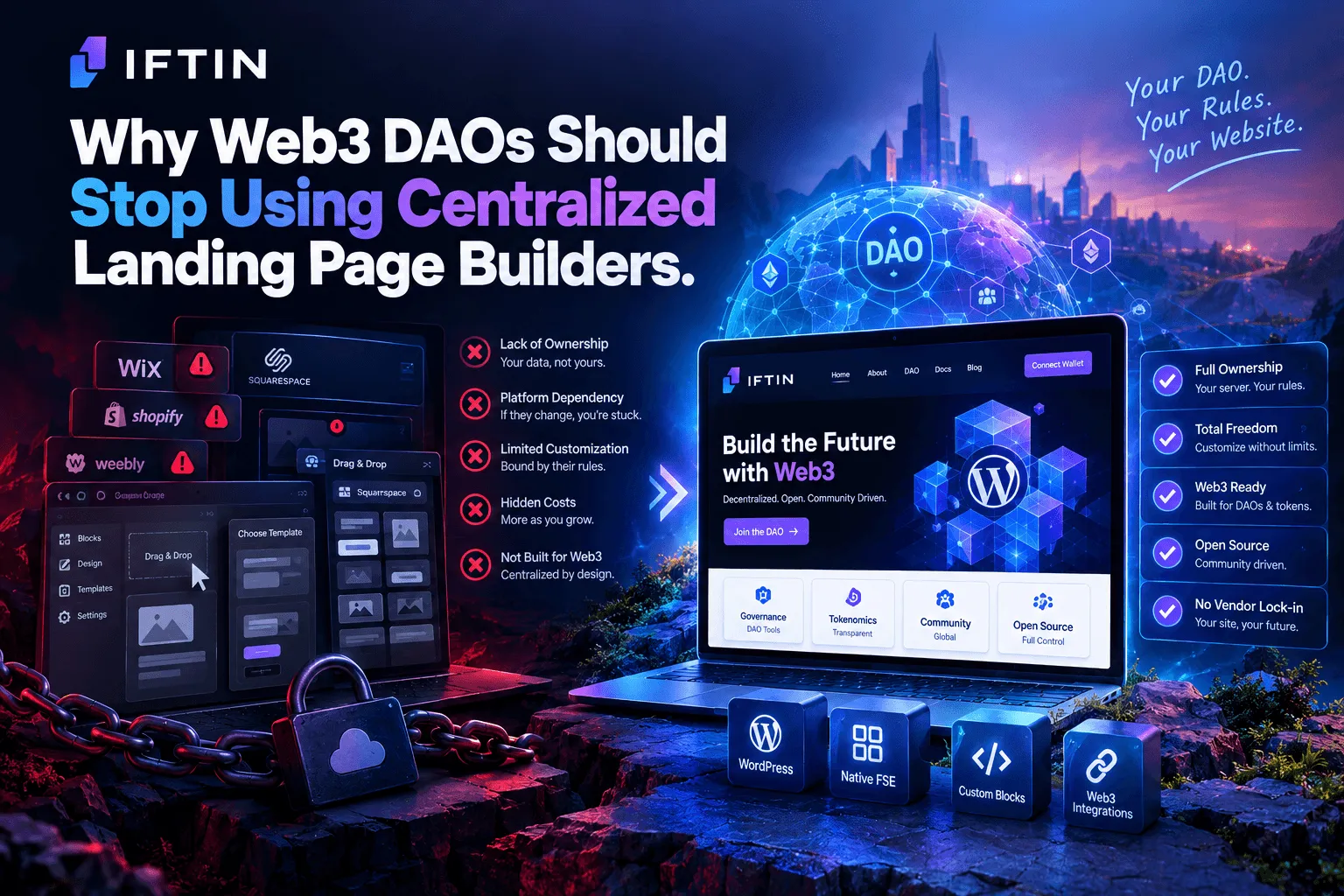
There’s a specific kind of cognitive dissonance when Web3 DAOs rely on centralized landing page builders, and it’s worth naming directly.
A DAO spends eighteen months designing a governance system where no single party can freeze funds. It audits its smart contracts. It distributes its multisig across five continents. It writes a constitution enshrining the principle that no central authority should control the protocol.
Then it builds its public website on Squarespace.
This isn’t a hypothetical. It’s the current state of most DAOs. The on-chain architecture is carefully decentralized. The off-chain infrastructure — the website that most community members and all prospective members interact with first — is fully controlled by a company that can remove it with a single click, with no warning, and with no obligation to provide an export.
The argument for changing this isn’t ideological purity. It’s operational risk management. The front end is where centralization actually hurts you.
Where DAOs Are Most Vulnerable
Smart contract exploits get the most attention when people discuss DAO security. They’re dramatic, expensive, and technically interesting. But the attack surface that actually affects most DAOs most often isn’t on-chain. It’s the web infrastructure that surrounds the protocol.
Consider what a DAO’s website actually contains:
Governance documentation. The rules by which the DAO operates, explained in language that community members can read and reference. If this goes offline, governance participation drops. New contributors can’t orient themselves. Disputes about how the DAO should operate become harder to resolve because the canonical reference point is unavailable.
Community entry points. Discord links, forum links, contributor onboarding guides. These are how the DAO grows. A DAO whose website goes down loses its ability to attract new participants for as long as it stays down.
Treasury transparency. Holdings, historical allocations, multi-sig addresses. For a DAO that has committed to financial transparency as a governance principle, publishing this information on infrastructure that can be taken down on twelve hours notice is architecturally inconsistent with that commitment.
Proposal history. What the DAO has decided, what was debated, what passed and what failed. This is the institutional memory of the organization. It should not be stored somewhere that can disappear.
None of these are hypothetical risks. DAOs have lost website access. Protocols have been deplatformed. A decentralized finance project that builds on AAVE or Compound for its financial layer but uses Webflow for its governance documentation has made a choice about where it’s acceptable to have a single point of failure. That choice is “everywhere the community actually goes.”
What Landing Page Builders Actually Do to Your Content
The marketing materials for SaaS website builders are designed to make you focus on what you’re gaining — speed, design quality, ease of use — without thinking carefully about what you’re trading.
What you’re trading is ownership.
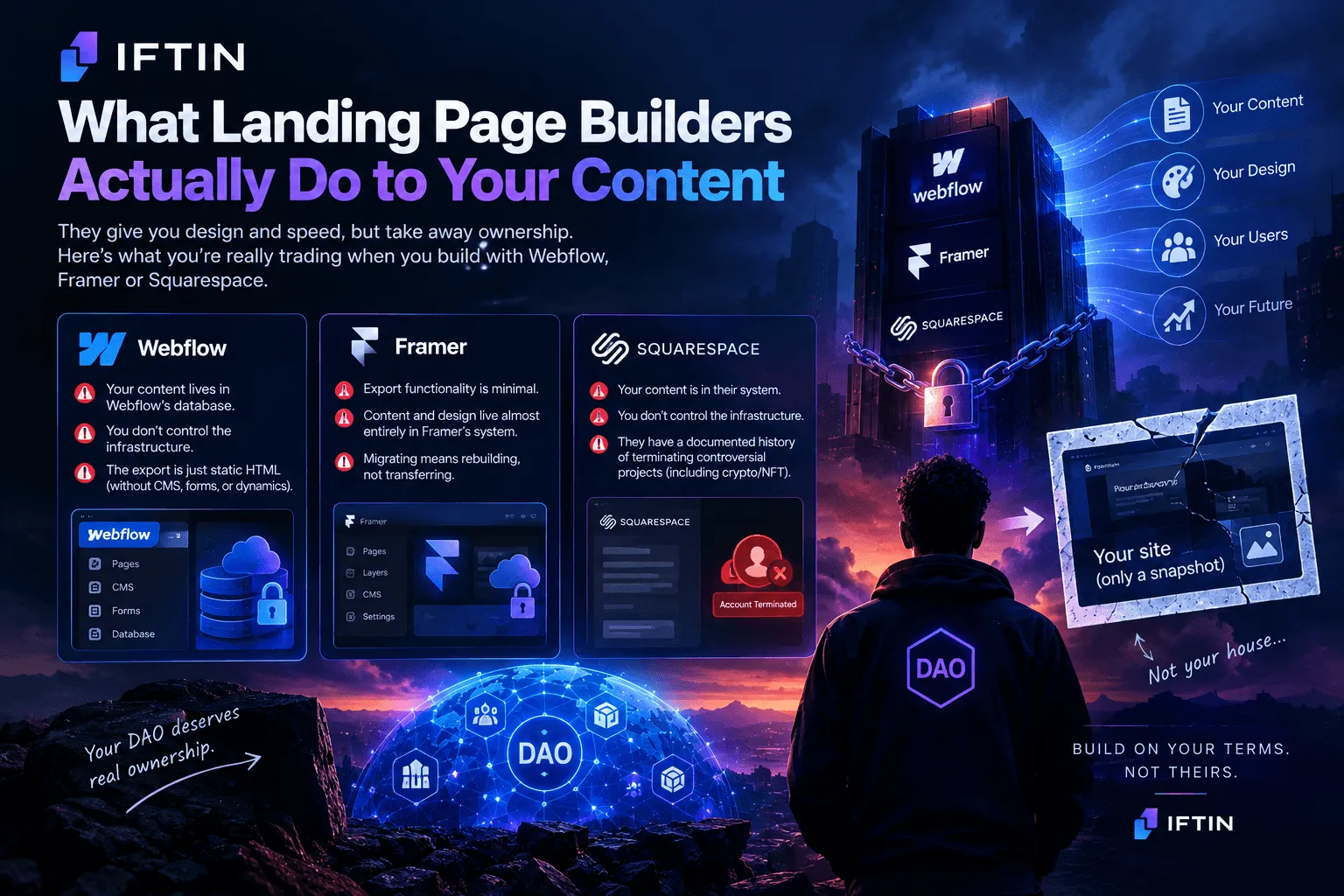
When a DAO builds its website on Webflow, the content lives in Webflow’s database. Not a copy in Webflow’s database. The content. The canonical version of your governance documentation, your tokenomics explanation, your treasury overview — it exists as rows in a database that Webflow controls, running on infrastructure that Webflow controls, accessible through a DNS record that Webflow controls.
The export option that Webflow and similar platforms provide is not a solution to this problem. It produces static HTML — a frozen snapshot of your site at a point in time, stripped of its CMS functionality, its dynamic content, its forms, and its ability to be edited without returning to Webflow. If your account is terminated, you have a photograph of your house. Not your house.
Framer is worse. The export functionality is minimal. The content and design exist almost entirely inside Framer’s proprietary system, and migrating away from Framer means rebuilding rather than migrating.
The Squarespace situation is particularly ironic for DAOs. Squarespace has historically been willing to terminate accounts for projects it considers controversial. The crypto and NFT space has generated several of these terminations. A DAO that uses Squarespace for its governance portal has chosen a platform with a documented history of deplatforming adjacent projects.
The Argument You’ll Hear for SaaS Builders — And Why It’s Weak
The defense of centralized builders usually takes one of three forms.
“We’ll migrate when we’re bigger.” This is the most common rationalization, and it’s backwards. Migrating a website gets harder as it grows. More content, more backlinks, more community expectations, more governance documentation that’s been cited in proposals and forum discussions — all of it becomes harder to move the longer you wait. The DAO that starts on Webflow and plans to migrate at some undefined future point of maturity is the DAO that will still be on Webflow when it matters most.
“We don’t have the technical capacity to self-host.” This was a more reasonable argument five years ago than it is today. Managed WordPress hosting that requires no server administration is available for less than ten dollars a month. The barrier to self-hosting WordPress is lower than the barrier to configuring a Webflow CMS properly. The argument assumes a level of technical difficulty that no longer exists.
“The censorship risk is theoretical.” It isn’t. It’s documented. Tornado Cash’s front end was taken down. Uniswap removed tokens from its interface under regulatory pressure. OpenSea has deplatformed projects. The argument that “it won’t happen to us” is not a risk assessment — it’s wishful thinking.
What Self-Hosted WordPress Actually Looks Like for a DAO
The practical difference between a DAO on Webflow and a DAO on self-hosted WordPress is smaller than most people imagine, and the architectural difference is larger.
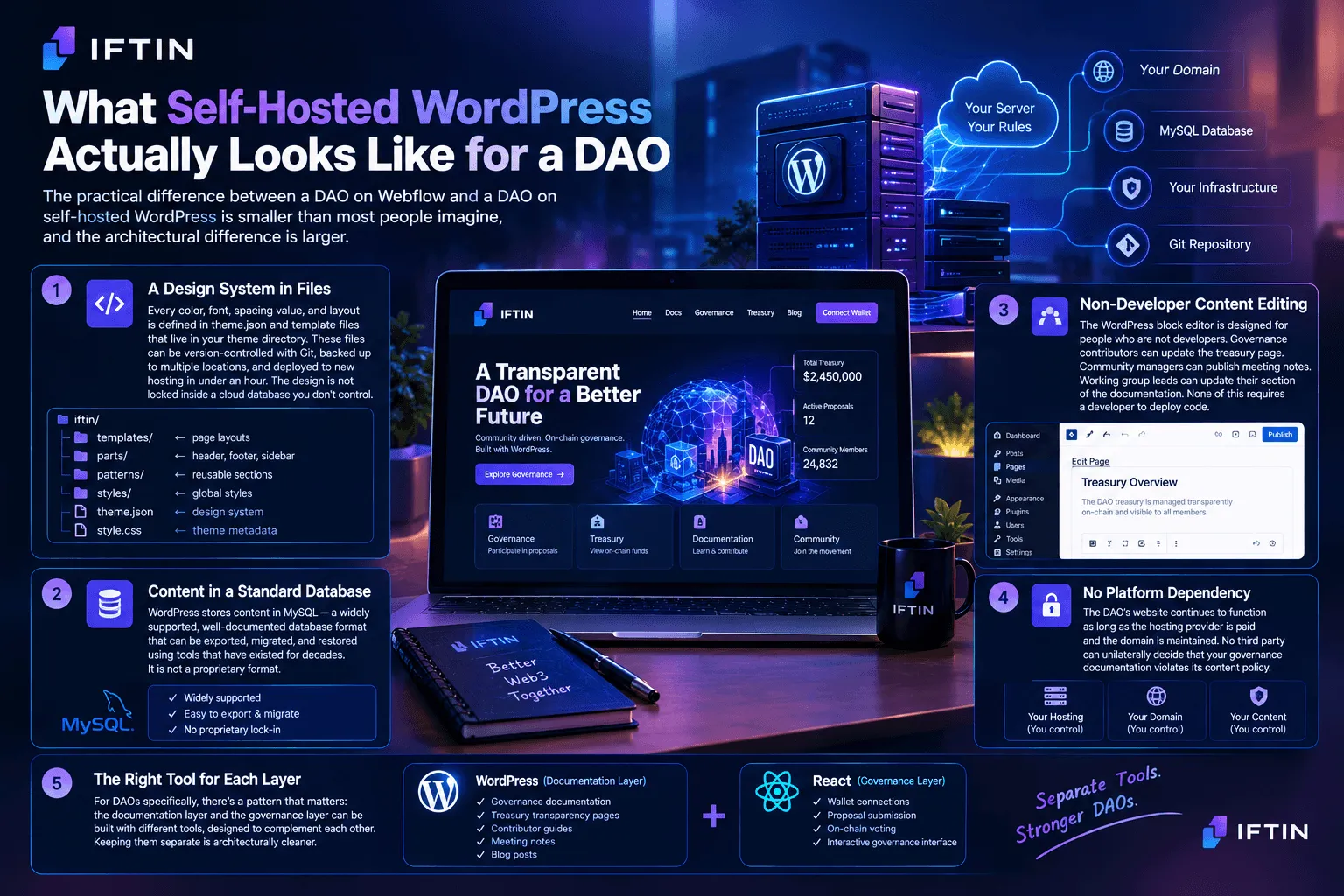
A self-hosted WordPress installation with a purpose-built block theme gives you:
A design system in files. Every color, font, spacing value, and layout is defined in theme.json and template files that live in your theme directory. These files can be version-controlled with Git, backed up to multiple locations, and deployed to new hosting in under an hour. The design is not locked inside a cloud database you don’t control.
Content in a standard database. WordPress stores content in MySQL — a widely supported, well-documented database format that can be exported, migrated, and restored using tools that have existed for decades. It is not a proprietary format. Every hosting provider in the world knows how to handle it.
Non-developer content editing. The WordPress block editor is designed for people who are not developers. Governance contributors can update the treasury page. Community managers can publish meeting notes. Working group leads can update their section of the documentation. None of this requires a developer to deploy code.
No platform dependency for continued operation. The DAO’s website continues to function as long as the hosting provider is paid and the domain is maintained. No third party can unilaterally decide that your governance documentation violates its content policy.
For DAOs specifically, there’s a pattern that matters: the documentation layer and the governance layer can be built with different tools, designed to complement each other. WordPress handles the content and documentation — governance documentation, treasury transparency pages, contributor guides, meeting notes, blog posts. A separate React application handles the interactive governance interface — wallet connections, proposal submission, on-chain voting. These are different problems that benefit from different tools, and keeping them separate rather than trying to do everything in one platform is architecturally cleaner.
The Governance Parallel Nobody Is Making
There’s a principle that serious DAO governance design takes seriously: no single actor should be able to unilaterally change the rules or freeze the assets.
The multi-sig thresholds, the timelock delays, the quorum requirements, the veto mechanisms — all of these exist to prevent a single point of control from being exploited, whether by a bad actor, a compromised key, or a government order.
The same principle applies to infrastructure. A single actor — Webflow, Squarespace, Framer, AWS, Netlify — should not be able to unilaterally take down your governance documentation, your community entry points, or your treasury transparency page.
If your DAO would not accept a governance structure where one entity could freeze all assets without consent of token holders, it should not accept an infrastructure structure where one company can take down the website without your consent.
This isn’t a rhetorical point. It’s the application of the same risk framework to a different layer. The DAO that has thought carefully about governance attack vectors and not thought about infrastructure attack vectors has left the most accessible layer of its public presence undefended.
What Changing This Actually Requires
Moving away from a centralized landing page builder is not a large project. It is a medium-sized one with a clear endpoint.
Choose your hosting. A managed WordPress host — Cloudways, Kinsta, or a VPS with a one-click WordPress install — gives you self-hosted WordPress without requiring server administration knowledge. The monthly cost is comparable to Webflow’s CMS plan.
Choose a purpose-built theme. A block theme built for Web3 organizations gives you the governance sections, treasury displays, tokenomics layouts, and DAO-specific patterns that you’d otherwise build from scratch. The design system is in theme.json — auditable, version-controllable, and portable.
Migrate your content. WordPress content migration tools are mature. Webflow has an export that can be imported. Framer requires more manual work. The migration has a cost, but it’s a one-time cost.
Set up Git for your theme. This is the step most teams skip and shouldn’t. The theme — all the design decisions, the templates, the patterns — goes in a Git repository. Now you have version history, rollback capability, and the ability to deploy to new hosting from the repository in under an hour.
Point your domain. DNS change. Your DAO’s URL now points to infrastructure you control.
The total time for a team that has done this once is a week of focused work. For a team doing it for the first time, two weeks is realistic. Against the operational risk that centralized builders represent for an organization built on decentralization, that’s a reasonable investment.
The Bottom Line: Moving Away from Centralized Landing Page Builders
The gap between what DAOs say about decentralization and what they actually do with their web infrastructure is not a minor inconsistency. It’s a meaningful vulnerability in the organizations that are supposed to demonstrate that decentralized coordination works at scale.
Centralized landing page builders are not the enemy. They’re useful tools that are simply wrong for this use case. A consumer brand using Squarespace faces no meaningful censorship risk. A DAO that uses Squarespace for its governance portal has made a choice that contradicts its architectural principles and creates a real, non-theoretical operational risk.
The alternative is not complicated. Self-hosted WordPress, a purpose-built block theme, a Git repository for the design, and a hosting provider in a jurisdiction you’ve chosen deliberately. Your content is yours. Your design is yours. Your infrastructure is yours.
For an organization whose entire value proposition rests on the idea that ownership and control should be distributed rather than concentrated, that baseline is not optional. It’s foundational.
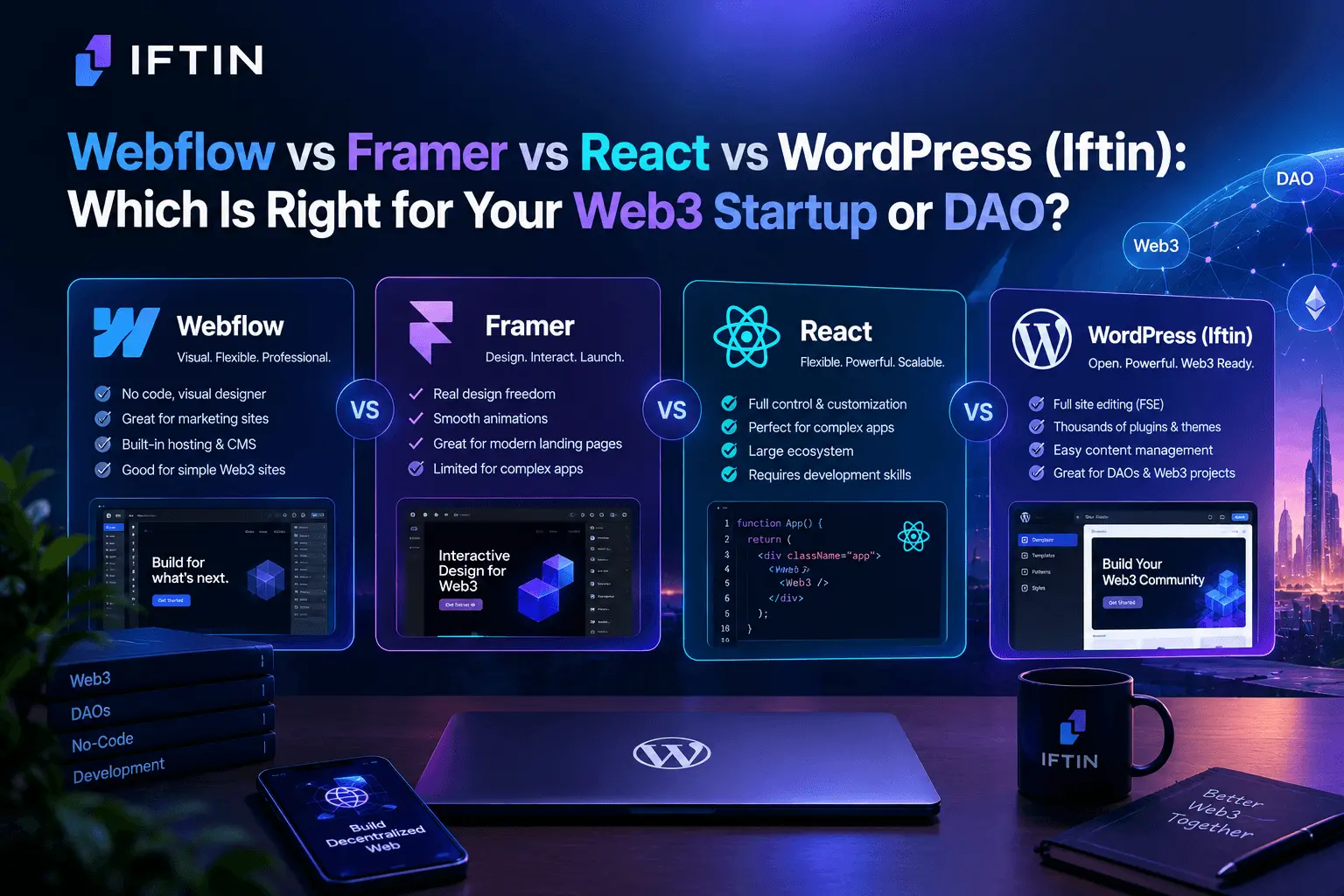
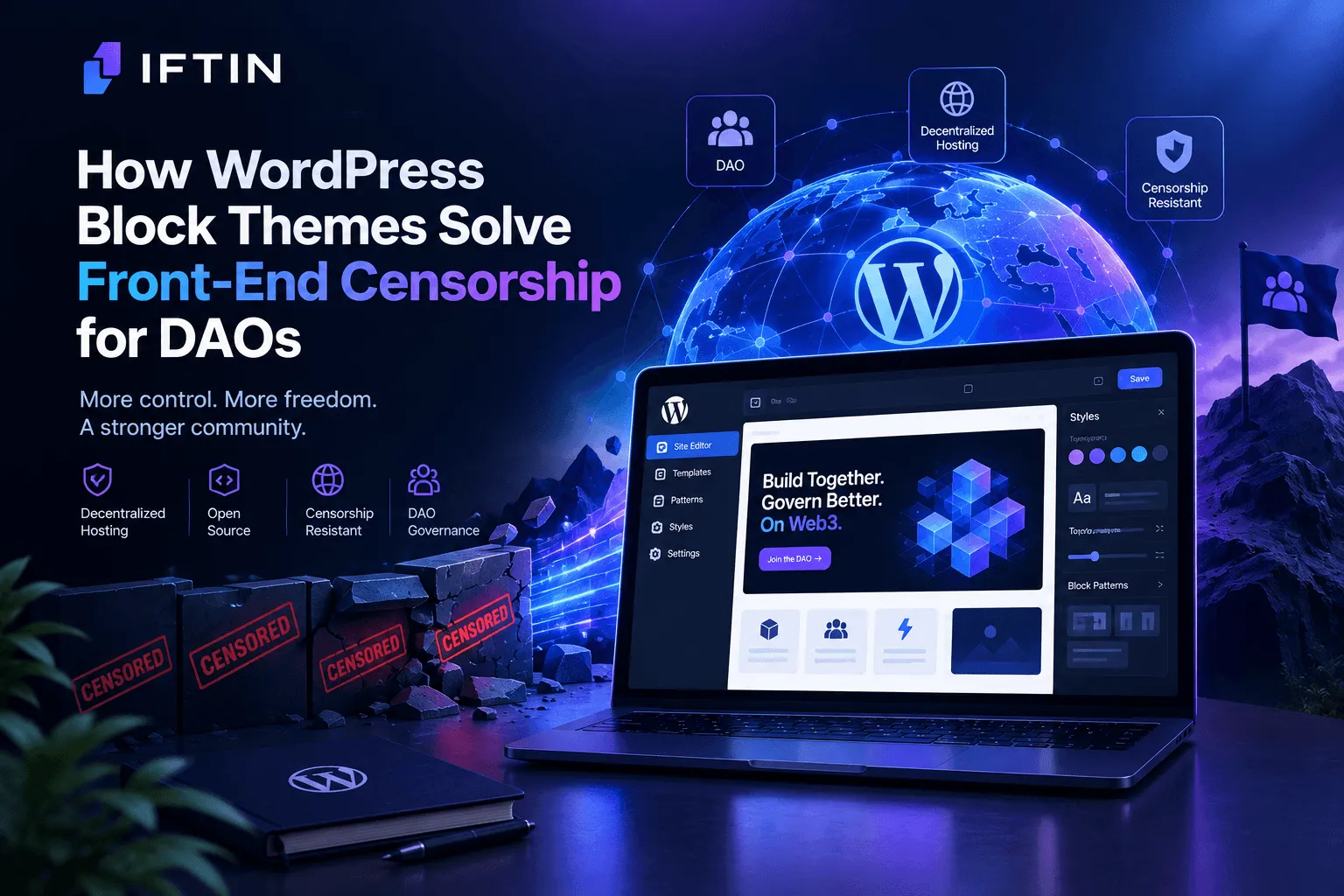
Want to go deeper? Read our guides on How WordPress Block Themes Solve Front-End Censorship for DAOs, Webflow vs Framer vs React vs WordPress for Web3, and How to Create a DAO Website Using WordPress FSE.