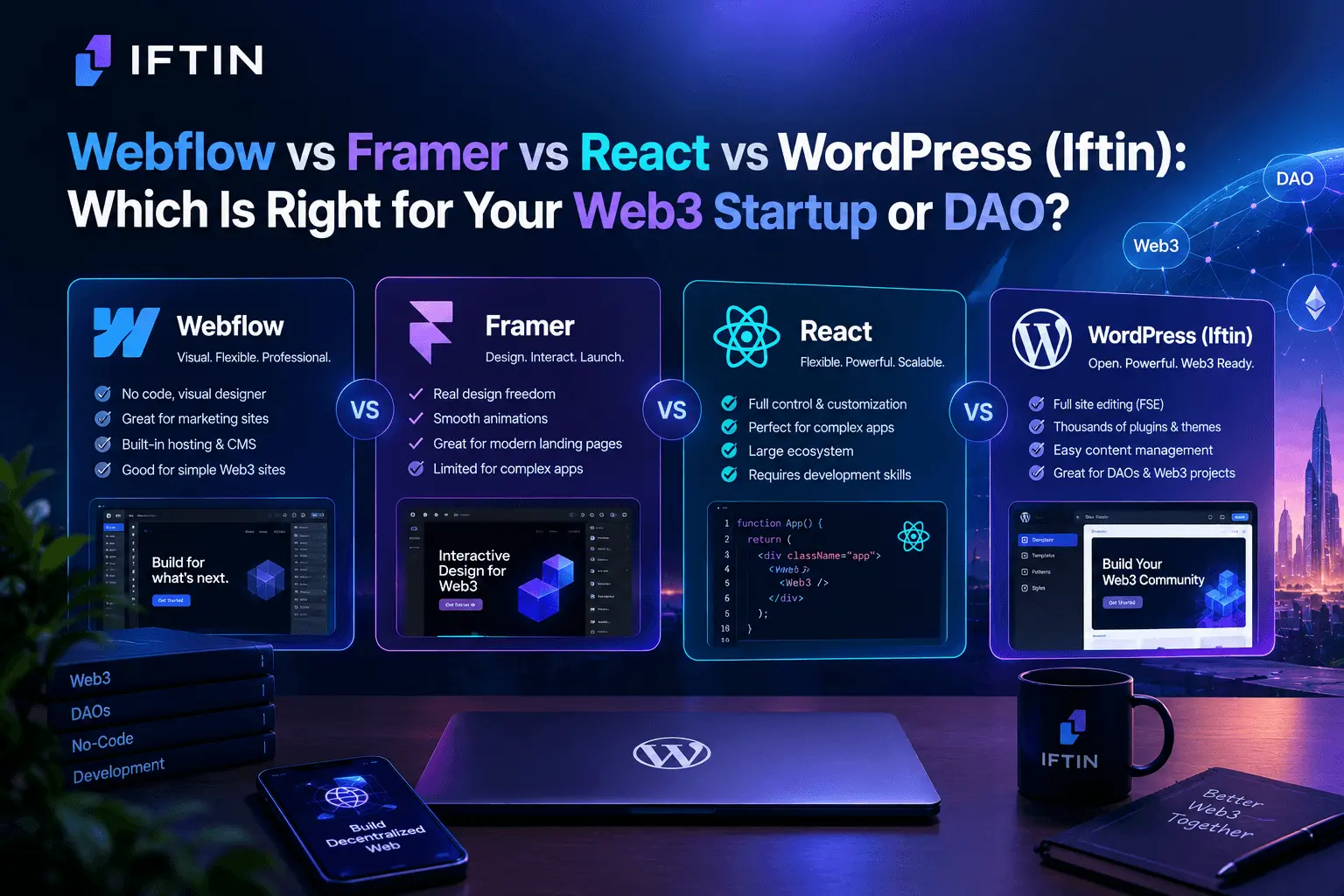
When comparing Webflow vs Framer vs React vs WordPress, every Web3 team eventually faces the same decision: what do we build the website on?
The options feel straightforward until you start asking the questions that actually matter for a decentralized organization. Can this platform be taken offline by a third party? Who owns the content if we stop paying? Can we version-control the design? What happens when the company behind this tool changes its pricing, gets acquired, or shuts down?
This guide compares the four most common options — Webflow, Framer, React, and WordPress with a purpose-built block theme — honestly, including the parts each vendor would prefer you didn’t think about.
The Four Options
Webflow
Webflow is a visual website builder that generates clean HTML, CSS, and JavaScript. It’s popular with design-forward teams who want pixel control without writing code. The product is genuinely good at what it does.
What it does well:
- Visual design control that’s closer to Figma than a typical website builder
- Clean code output compared to drag-and-drop alternatives
- CMS functionality for blog posts and dynamic content
- Reasonable performance out of the box
What it doesn’t tell you upfront:
Your site lives on Webflow’s infrastructure. Your content is stored in Webflow’s database. Your design exists as configuration inside Webflow’s proprietary system. You can export HTML and CSS, but the export is static — it removes the CMS, the forms, the dynamic functionality, and the ability to make further visual edits without returning to Webflow.
For a DAO, this matters in a specific way. If Webflow decides your project violates its terms of service — and crypto and DeFi projects have been deplatformed by SaaS companies before — you lose your hosting, your CMS, and your design tooling simultaneously. The export you’re left with is a frozen snapshot that requires a developer to modify.
Webflow’s pricing has also increased significantly since its early growth phase. The CMS plan required for most serious sites runs $23–$39/month. Enterprise pricing is opaque. For a DAO operating on a treasury budget with governance approval processes, unpredictable pricing is a real operational risk.
Framer
Framer positioned itself as a design tool first and a website builder second. It produces visually impressive results quickly, particularly for landing pages with animation and motion design.
What it does well:
- Fastest path from design to published landing page
- Strong animation and interaction capabilities
- Good for single landing pages and marketing sites
- Component-based workflow familiar to product designers
What it doesn’t tell you upfront:
Framer is even more platform-dependent than Webflow. The content and design live entirely in Framer’s cloud. There is no meaningful export. If Framer raises prices, changes terms, or closes — and it is a venture-funded startup with no guarantee of longevity — your site is gone.
For a DAO governance portal or a DeFi protocol’s primary web presence, Framer is close to the worst architectural choice available. It optimizes for speed of initial creation at the direct expense of long-term ownership and portability. The governance sections, treasury displays, and documentation pages that a DAO needs are poorly served by a tool designed primarily for landing pages.
Framer also loads a significant amount of JavaScript to render pages that could be static HTML. For audiences who are privacy-conscious — which Web3 communities tend to be — the tracking and analytics infrastructure that comes bundled with SaaS website builders is a reputational consideration as much as a technical one.
React
React is a JavaScript library for building user interfaces. Unlike Webflow and Framer, it’s not a website builder — it’s a programming tool. Choosing React means building a custom application from scratch.
What it does well:
- Complete control over every aspect of the application
- Excellent for complex interactive interfaces
- Strong ecosystem of libraries and tooling
- The right choice for the dApp interface layer — wallet connections, on-chain reads, governance voting interfaces
What it doesn’t tell you upfront:
React is not a website. It’s a library. Choosing React for your marketing site, documentation, and blog means building and maintaining infrastructure that WordPress provides out of the box: routing, content management, SEO tooling, image optimization, user authentication, and deployment pipelines.
A Web3 team that chooses React for everything — marketing site, docs, governance portal, and dApp interface — is committing to maintaining all of that infrastructure indefinitely. Every developer who joins needs to understand the custom setup. Every content update requires a developer or a custom CMS integration. Every SEO change requires code deployment.
React is the correct choice for the parts of a DAO’s digital presence that need to interact with wallets and read on-chain state. It is a poor choice for the content and documentation layer that forms most of a public website.
The hidden cost of React for content sites is developer time. A DeFi protocol that uses React for its marketing site is paying senior engineering salaries to solve problems that a well-configured WordPress installation handles for free.
WordPress with Iftin (Block Theme + Self-Hosted)
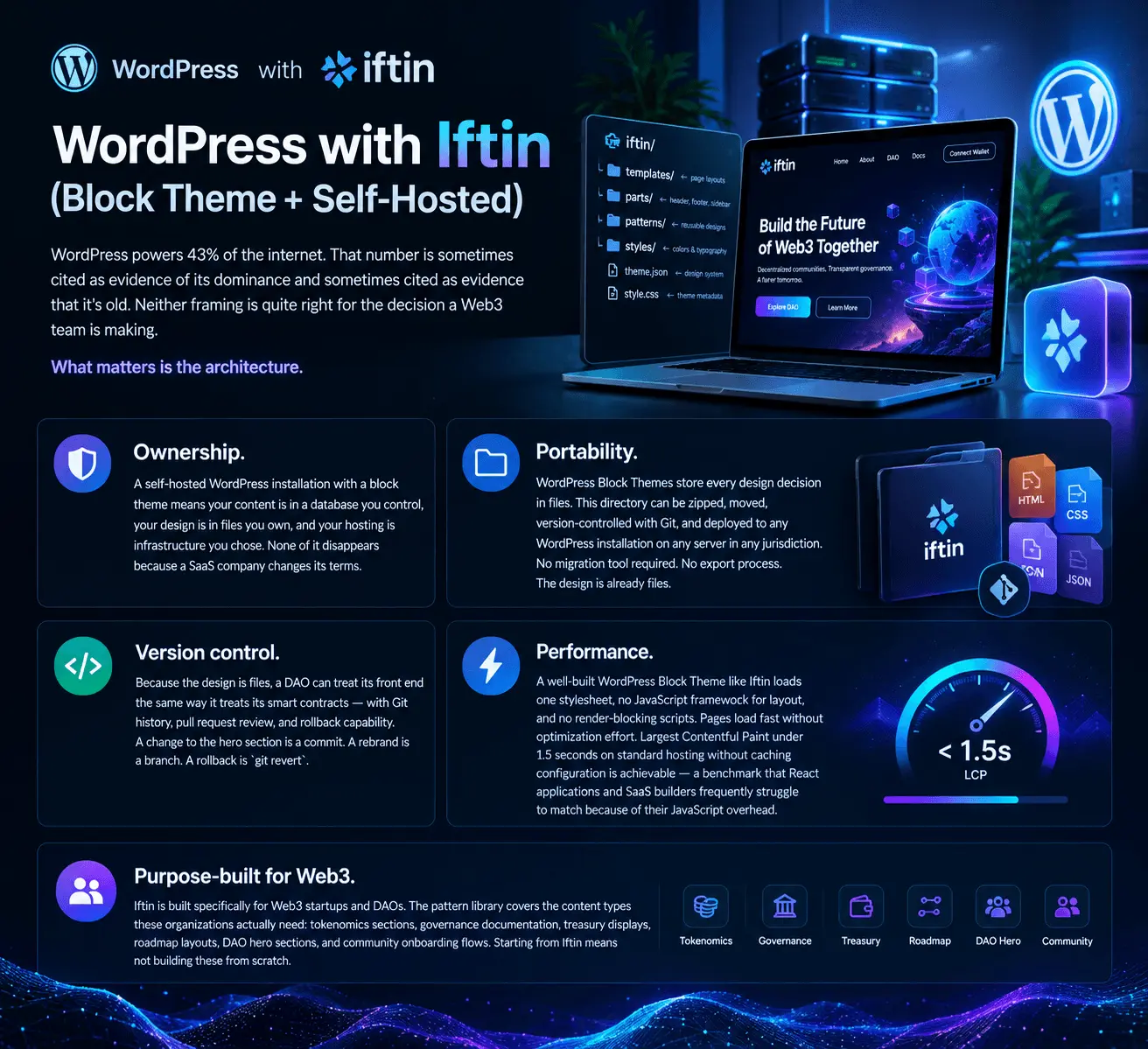
WordPress powers 43% of the internet. That number is sometimes cited as evidence of its dominance and sometimes cited as evidence that it’s old. Neither framing is quite right for the decision a Web3 team is making.
What matters is the architecture.
What it does well:
Ownership. A self-hosted WordPress installation with a block theme means your content is in a database you control, your design is in files you own, and your hosting is infrastructure you chose. None of it disappears because a SaaS company changes its terms.
Portability. WordPress Block Themes store every design decision in files:
iftin/
├── templates/     ← page layouts as HTML files
├── parts/         ← header, footer, sidebar
├── patterns/      ← reusable section designs
├── styles/        ← color and typography variations
├── theme.json     ← global design system
└── style.css      ← theme metadata
This directory can be zipped, moved, version-controlled with Git, and deployed to any WordPress installation on any server in any jurisdiction. No migration tool required. No export process. The design is already files.
Version control. Because the design is files, a DAO can treat its front end the same way it treats its smart contracts — with Git history, pull request review, and rollback capability. A change to the hero section is a commit. A rebrand is a branch. A rollback is git revert.
Performance. A well-built WordPress Block Theme like Iftin loads one stylesheet, no JavaScript framework for layout, and no render-blocking scripts. Pages load fast without optimization effort. Largest Contentful Paint under 1.5 seconds on standard hosting without caching configuration is achievable — a benchmark that React applications and SaaS builders frequently struggle to match because of their JavaScript overhead.
Purpose-built for Web3. Iftin is built specifically for Web3 startups and DAOs. The pattern library covers the content types these organizations actually need: tokenomics sections, governance documentation, treasury displays, roadmap layouts, DAO hero sections, and community onboarding flows. Starting from Iftin means not building these from scratch.
What it doesn’t do:
WordPress is not the right tool for the wallet connection interface. The JavaScript application that reads on-chain state, displays live token balances, and submits governance votes belongs in React — specifically, in a separate application hosted on IPFS or a decentralized storage layer. WordPress handles the content and documentation layer. React handles the application layer. These are different problems.
WordPress also requires more initial setup than Webflow or Framer. A self-hosted installation needs a server, a domain pointed to that server, and WordPress installed before any design work begins. For a team with no one who has done this before, the first hour is unfamiliar. After that, it’s straightforward.
The Comparison That Actually Matters for DAOs
The standard comparison axes — design quality, ease of use, pricing — are fine for a SaaS startup choosing a marketing site. They’re insufficient for a DAO.
The questions a DAO should be asking are different:
Can this be taken offline by a third party without our consent?
| Platform | Answer |
|---|---|
| Webflow | Yes — Webflow can terminate your account |
| Framer | Yes — Framer can terminate your account |
| React (on Vercel/Netlify) | Yes — your host can terminate your account |
| WordPress (self-hosted) | Your hosting provider can, but you can redeploy from Git in hours |
Can we migrate without losing our design?
| Platform | Answer |
|---|---|
| Webflow | Partial — static HTML export, no CMS |
| Framer | No meaningful export |
| React | Yes, but you’re migrating a codebase |
| WordPress (Block Theme) | Yes — the theme is files, the content is a standard database export |
Can non-developers update content?
| Platform | Answer |
|---|---|
| Webflow | Yes |
| Framer | Limited |
| React | No, without a separate CMS |
| WordPress | Yes — the block editor is designed for this |
Does the design system live in version control?
| Platform | Answer |
|---|---|
| Webflow | No — it’s in Webflow’s database |
| Framer | No — it’s in Framer’s cloud |
| React | Yes, if you built it that way |
| WordPress (Block Theme) | Yes — theme.json and template files are Git-trackable |
Is the pricing predictable and under our control?
| Platform | Answer |
|---|---|
| Webflow | No — SaaS pricing can change |
| Framer | No — venture-funded, pricing history is short |
| React | Depends on hosting choice |
| WordPress | Hosting cost is the only variable; the software is free |
The Right Architecture for a Web3 Organization
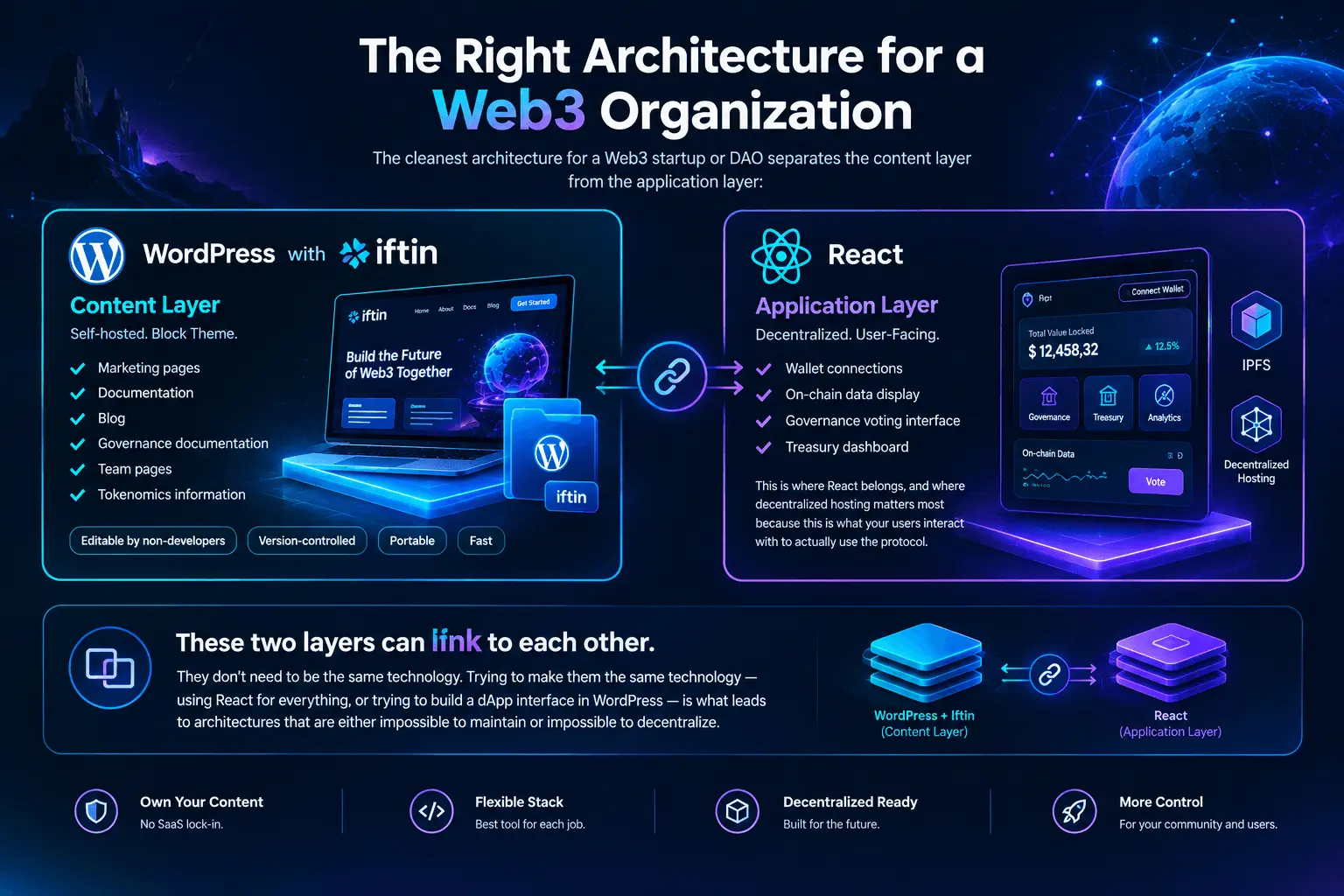
The cleanest architecture for a Web3 startup or DAO separates the content layer from the application layer:
Content layer — WordPress with Iftin, self-hosted. Marketing pages, documentation, blog, governance documentation, team pages, tokenomics information. Editable by non-developers. Version-controlled. Portable. Fast.
Application layer — React, deployed to IPFS or a decentralized host. Wallet connections, on-chain data display, governance voting interface, treasury dashboard. This is where React belongs, and where decentralized hosting matters most because this is what your users interact with to actually use the protocol.
These two layers can link to each other. They don’t need to be the same technology. Trying to make them the same technology — using React for everything, or trying to build a dApp interface in WordPress — is what leads to architectures that are either impossible to maintain or impossible to decentralize.
When Each Tool Is Actually the Right Choice
Choose Webflow if: You need a polished marketing site fast, your team has no WordPress experience, your DAO has no realistic censorship risk, and you’re comfortable with the platform dependency in exchange for design speed.
Choose Framer if: You need a single landing page with strong visual impact for a short-term campaign and you have no expectation of the site lasting more than a year.
Choose React if: You’re building the dApp interface layer — wallet connections, on-chain data, voting interfaces. This is what React is for.
Choose WordPress with Iftin if: You’re building the content and documentation layer of a Web3 startup or DAO’s presence, you care about long-term ownership of your design and content, you want the design to be version-controlled, you want non-developers to be able to update content, and you want infrastructure that aligns with the decentralization values your organization is built on.
The Bottom Line: Webflow vs Framer vs React vs WordPress
Webflow and Framer are good products for the problems they were designed to solve. Those problems are not the problems a DAO has.
A decentralized organization that hosts its governance documentation on a platform that can deplatform it, stores its design in a proprietary cloud it can’t export, and depends on a SaaS company’s continued operation and favorable pricing has made a set of infrastructure choices that contradict its organizational values.
WordPress Block Themes, self-hosted, with a purpose-built theme like Iftin, don’t give you the fastest path to a published website. They give you the most durable one. The design is yours. The content is yours. The infrastructure is yours. The pricing is predictable. The deployment is portable.
For an organization built on the premise that ownership and decentralization matter, that’s not a feature. That’s the baseline.
Want to go deeper? Read our guides on How WordPress Block Themes Solve Front-End Censorship for DAOs, How to Create a DAO Website Using WordPress FSE, and The Complete Guide to WordPress Block Themes for Startups.