In late 2023, the front end of Tornado Cash — one of the most widely used privacy protocols on Ethereum — was taken offline. The smart contracts kept running. The protocol itself was untouched. But the website that let ordinary users interact with it was gone, and the domain was seized.
This wasn’t an isolated incident. It was a preview of a problem every serious DAO will eventually face: the infrastructure holding your front end is almost certainly more vulnerable to censorship than the protocol it represents.
The irony is predictable. Teams spend months designing governance mechanisms, auditing smart contracts, and decentralizing decision-making — then host their public-facing website on a SaaS platform that can be deplatformed with a single support ticket.
WordPress Block Themes, combined with self-hosting, offer a concrete alternative. Not a perfect one. But a meaningfully better one.
The Front-End Censorship Problem
To understand why this matters, it helps to be precise about what “front-end censorship” actually means and where the vulnerabilities live.
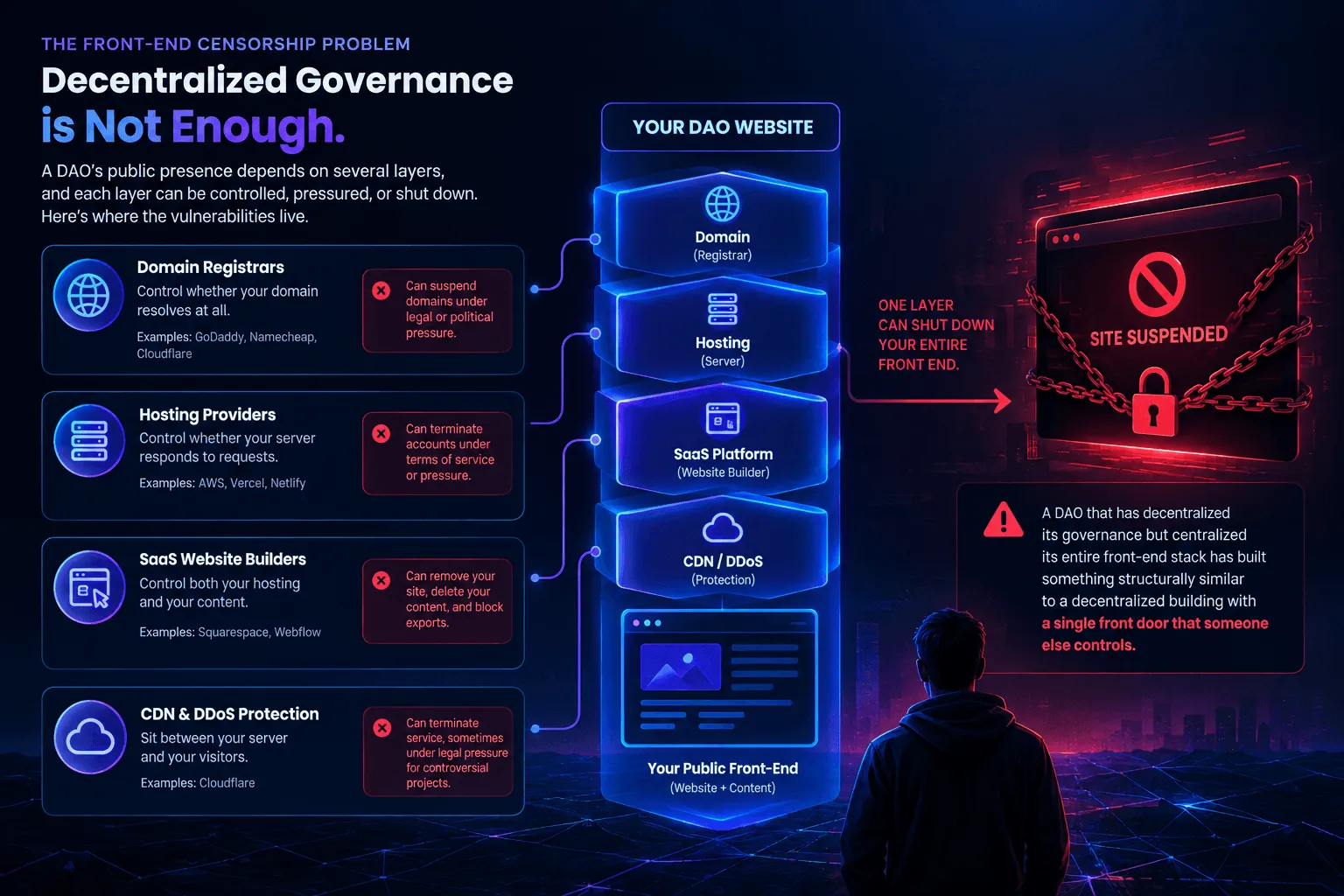
A DAO’s public presence typically depends on several distinct layers, each with its own failure modes:
Domain registrars control whether your domain resolves at all. Registrars like GoDaddy, Namecheap, and even Cloudflare have suspended domains under legal or political pressure. When a domain is suspended, your website disappears regardless of where it’s hosted.
Hosting providers control whether your server responds to requests. AWS, Vercel, Netlify, and similar platforms have terms of service that permit them to terminate accounts. Several have done so. A DAO whose governance portal runs on Netlify has a single point of failure that has nothing to do with its on-chain architecture.
SaaS website builders add another layer of dependency. Squarespace, Webflow, and similar platforms control both your hosting and your content. When a platform decides your project violates its terms — or receives pressure from regulators to remove it — you lose everything simultaneously: your hosting, your content, and often your ability to export it cleanly.
CDN and DDoS protection providers like Cloudflare sit between your server and your visitors. They can terminate service, and in some cases have done so for controversial projects under legal pressure.
Each of these layers is a potential censorship vector. A DAO that has decentralized its governance but centralized its entire front-end stack has built something structurally similar to a decentralized building with a single front door that someone else controls.
Why Most DAOs Ignore This Until It’s Too Late
The answer is simple: building a website on Vercel is fast, cheap, and convenient. SaaS website builders require no infrastructure knowledge. The risk seems abstract until it materializes.
There’s also a common misconception that smart contract immutability extends to the front end. It doesn’t. The contracts are immutable. The website that lets users interact with those contracts is not. When the front end goes down, the protocol continues to exist but becomes practically inaccessible to anyone who doesn’t know how to interact with it directly through the contract ABI.
For established DeFi protocols with technical communities, this is a manageable temporary problem. For governance-dependent DAOs that rely on their website for proposal discussion, voting participation, and treasury transparency, a front-end outage is an organizational crisis.
What Self-Hosted WordPress Block Themes Actually Solve
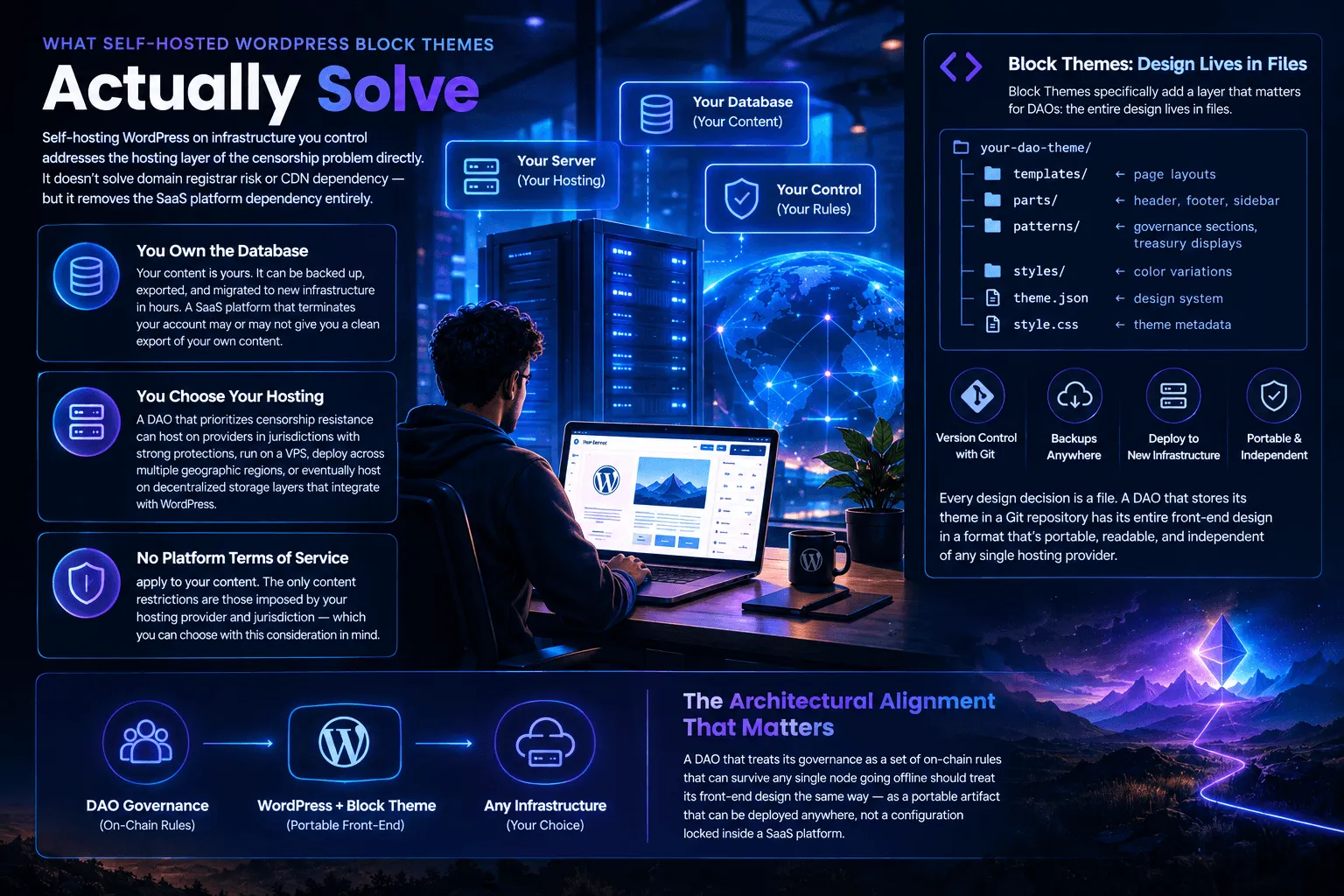
Self-hosting WordPress on infrastructure you control addresses the hosting layer of the censorship problem directly. It doesn’t solve domain registrar risk or CDN dependency — those require separate decisions — but it removes the SaaS platform dependency entirely.
With a self-hosted WordPress installation:
You own the database. Your content is yours. It can be backed up, exported, and migrated to new infrastructure in hours. A SaaS platform that terminates your account may or may not give you a clean export of your own content.
You choose your hosting. A DAO that prioritizes censorship resistance can host on providers in jurisdictions with strong protections, run on a VPS, deploy across multiple geographic regions, or eventually host on decentralized storage layers that integrate with WordPress.
No platform terms of service apply to your content. The only content restrictions are those imposed by your hosting provider and jurisdiction — which you can choose with this consideration in mind.
Block Themes specifically add a layer that matters for DAOs: the entire design lives in files.
your-dao-theme/
├── templates/     ← page layouts
├── parts/         ← header, footer, sidebar
├── patterns/      ← governance sections, treasury displays
├── styles/        ← color variations
├── theme.json     ← design system
└── style.css      ← theme metadata
Every design decision is a file. Files can be version-controlled with Git, backed up to multiple locations, and deployed to new infrastructure without losing anything. A DAO that stores its theme in a Git repository has its entire front-end design in a format that’s portable, readable, and independent of any single hosting provider.
This is the architectural alignment that matters: a DAO that treats its governance as a set of on-chain rules that can survive any single node going offline should treat its front-end design the same way — as a portable artifact that can be deployed anywhere, not a configuration locked inside a SaaS platform.
The Practical Implementation
Building a censorship-resistant DAO front end with WordPress Block Themes involves decisions at several levels.
Hosting
The hosting choice is the most consequential. Some options worth considering:
VPS hosting in privacy-friendly jurisdictions — Providers in countries with strong data protection laws and limited extradition agreements for digital content give you more time and legal recourse if challenged. This doesn’t make you immune, but it changes the calculus.
Multiple deployment targets — A DAO that maintains its theme in a Git repository can deploy to multiple hosts simultaneously. If one goes down, DNS can be updated to point to another within minutes.
Decentralized storage integration — Projects like IPFS and Arweave can host static versions of WordPress-generated content. Tools exist to export WordPress content to static HTML, which can then be pinned to IPFS. This doesn’t give you the full dynamic WordPress experience, but it can give you a resilient fallback that’s extraordinarily difficult to take down.
Domain Strategy
Domain registrar risk is real and often overlooked. Some options:
ENS domains — Ethereum Name Service domains like yourdao.eth are controlled by smart contracts, not registrars. They can’t be seized the way traditional domains can. Browser support is still limited but growing, and plugins exist to resolve ENS domains directly.
Decentralized DNS — Services like Handshake offer domain names anchored to a blockchain rather than ICANN. Adoption is limited but the infrastructure exists.
Multiple traditional domains — Registering your site under several traditional domains in different jurisdictions provides redundancy. If one is suspended, others remain accessible.
Theme Architecture
A WordPress Block Theme designed for censorship resistance should prioritize portability:
Version control everything. Every template, pattern, and style variation should be in Git. This means you can deploy your entire front end to new infrastructure from a repository in minutes.
Self-host all assets. Fonts loaded from Google Fonts, images served from a CDN, and scripts loaded from third-party hosts all create external dependencies that can fail or be blocked. A Block Theme that loads everything locally — fonts in assets/fonts/, images in assets/images/ — has no external dependencies that can be disrupted.
Document your deployment process. A DAO whose core team knows exactly how to spin up the front end on new infrastructure is more resilient than one that relies on institutional memory or a single developer.
What Block Themes Don’t Solve
Honesty about limitations matters here, and the DAO community has a reasonable allergy to overclaiming.
Domain registrar risk remains. If your domain is suspended, your self-hosted WordPress installation goes dark for most users regardless of how well you’ve built it. Solving this requires either ENS, Handshake, or maintaining multiple domains — not a WordPress decision.
Hosting provider risk remains at some level. Unless you’re hosting on decentralized infrastructure — which comes with real tradeoffs in performance and maintenance — you have a hosting provider who can terminate service. Self-hosting removes the SaaS layer but doesn’t eliminate hosting dependency.
Cloudflare dependency is a choice, not a requirement. Many self-hosted WordPress sites use Cloudflare for DDoS protection and performance. This reintroduces a centralized dependency. Running without Cloudflare exposes you to DDoS attacks that can effectively take your site offline. This is a real tradeoff with no clean answer.
The smart contract front end is a separate problem. Your governance portal, swap interface, or treasury dashboard — the JavaScript application that connects to wallets and reads on-chain state — is a different artifact from your marketing and documentation website. Hosting that on IPFS, as many protocols now do, is the correct approach for that layer. WordPress is for the content and documentation layer, not the dApp interface.
The Governance Parallel
The architectural principle behind censorship-resistant front ends is the same one that makes good DAO governance: no single point of control.
A DAO that routes all governance through a single forum, or requires a single multisig holder to execute all decisions, or concentrates infrastructure decisions in one person has a censorship and failure risk regardless of how the on-chain contracts are written.
The same logic applies to the front end. A governance portal that lives on a single SaaS platform, whose content is locked in a proprietary database, whose design can’t be migrated without losing months of work, has a single point of failure at the exact layer that most users interact with.
WordPress Block Themes, self-hosted and version-controlled, reduce that single point of failure to several smaller, more manageable ones. The domain can be seized — but you can switch domains. The hosting provider can terminate — but you can deploy to a new host from Git in hours. The design can be duplicated — you control the files.
That’s not perfect decentralization. But it’s meaningfully better than what most DAOs are running today.
The Bottom Line
Front-end censorship is a real and underappreciated risk for DAOs. The smart contracts may be immutable, but the website that makes them accessible to ordinary users is not — and most DAOs have built that website on infrastructure that can be removed by a single actor with a support ticket.
WordPress Block Themes, combined with self-hosting and thoughtful infrastructure decisions, don’t eliminate this risk. They do address the most common and preventable layer of it: SaaS platform dependency. The design is in files. The content is in a database you own. The deployment is from a repository you control.
For a DAO that takes decentralization seriously as an operating principle, the question isn’t whether to self-host. It’s how to do it in a way that matches the resilience the protocol itself was designed to have.
Want to go deeper? Read our guides on How to Create a DAO Website Using WordPress FSE, DAO Website Design Best Practices, and Why Block Themes Are Perfect for Web3 Landing Pages.